White Paper
Pinnacle Ecosystem · Lunar Energy Sovereignty · Year 2100 Standard
Humanity stands at the threshold of its first permanent off-world civilization. The greatest barrier is not distance, radiation, or logistics — it is energy.
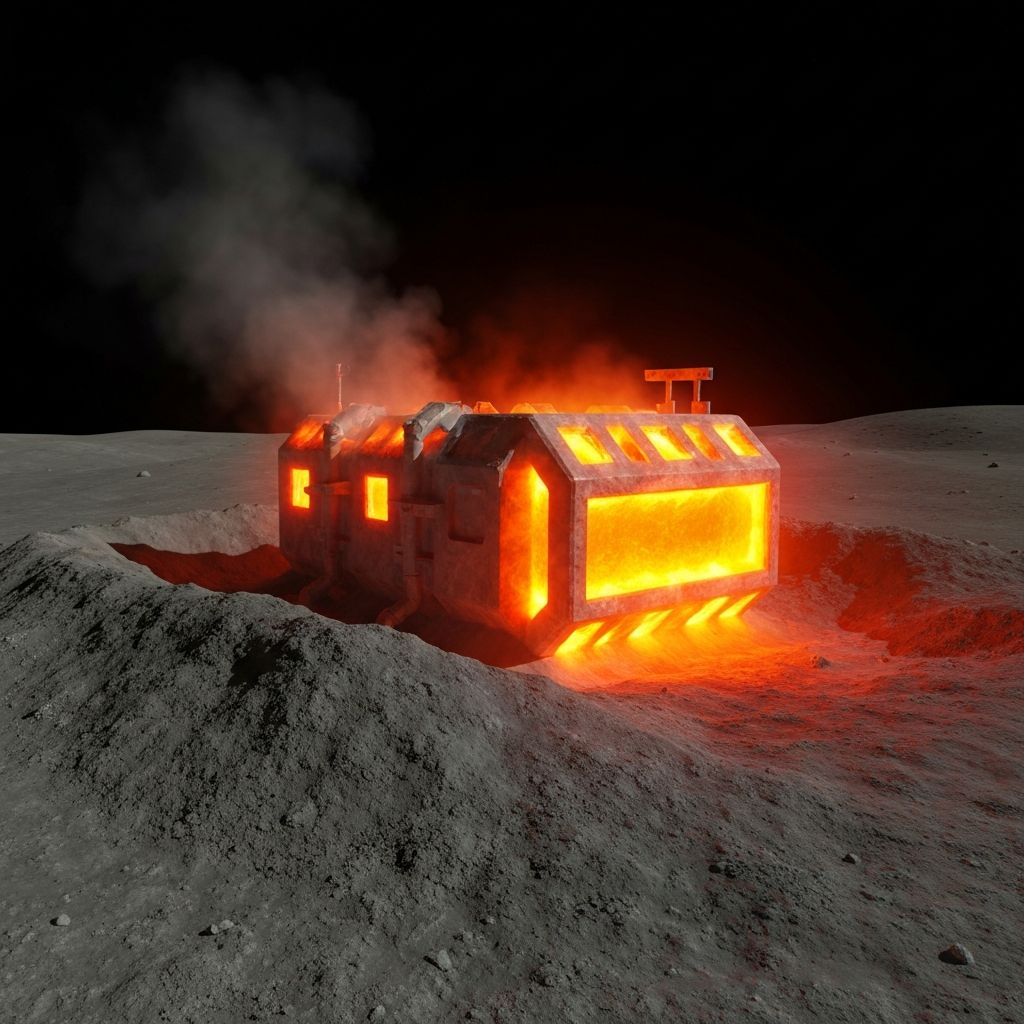
The 354-hour lunar night has historically made long-duration habitation impossible. RegoForge Power resolves this constraint with a thermal-storage architecture built entirely from the Moon itself.
This white paper outlines the physics, engineering, and civilization-scale implications of a regolith-based thermal energy system capable of powering the Moonstruck settlement and all future Pinnacle off-world infrastructure.
The Lunar Energy Problem
The Moon's night cycle — fourteen days of darkness — eliminates traditional solar power. Batteries degrade. Fuel cells require consumables. Nuclear reactors introduce mass, shielding, and political complexity.
A permanent lunar settlement requires an energy system that meets five critical criteria:
RegoForge Power is the first system to meet all five criteria.
The RegoForge Thermal Architecture
RegoForge Power transforms the Moon's regolith into a sovereign energy asset through four integrated processes:
Harvest
Regolith is abundant, stable, and naturally suited for thermal mass. It becomes the foundation of the lunar energy economy.
Concentrate
High-efficiency solar concentrators focus unfiltered sunlight into thermal vaults, achieving temperatures exceeding 1,200°C.
Store
Sintered regolith vaults retain heat with near-perfect efficiency due to the Moon's vacuum environment — the best insulation in the solar system.
Extract
Stirling engines convert stored heat into electricity throughout the lunar night, delivering continuous, predictable power.
This architecture is chemistry-agnostic, radiation-proof, and infinitely repeatable.
Performance Advantages
RegoForge Power outperforms all competing lunar energy systems:
MASS EFFICIENCY (per kW for 14-day night)
CYCLE LIFE
IN-SITU UTILIZATION
RegoForge is the only system that becomes more powerful as the settlement grows, because its fuel — regolith — is everywhere.
Integration with Moonstruck Settlement
RegoForge Power is the backbone of Moonstruck, the first permanent lunar settlement. It supports:
RegoForge is not an accessory — it is the enabling technology for lunar civilization.
Deployment Roadmap
Phase I
2027–202810–50 kW demonstrator; autonomous concentrator array; thermal vault validation.
Phase II
2029–2030100–500 kW human-rated system; settlement-scale thermal grid; ISRU integration.
Phase III
2031+1–10 MW industrial grid; full Moonstruck support; expansion to additional sites.
Civilization-Scale Implications
RegoForge Power establishes the first true off-world energy economy. It enables:
This is not a power system.
It is the infrastructure of a multi-planetary species.
Assumptions and Constraints
The RegoForge architecture is built upon validated engineering assumptions derived from lunar science data and aerospace thermal systems heritage.
Regolith Composition
Lunar regolith averages 45% oxygen by mass, with silicates and metal oxides providing consistent thermal properties across equatorial and polar sites.
Solar Flux
Unattenuated solar irradiance of 1,361 W/m² available during lunar day; concentrator efficiency targets 85% optical capture.
Thermal Retention
Sintered regolith thermal mass retains heat with <2% loss per Earth-day under vacuum conditions at operating temperatures of 1,000–1,200°C.
Vacuum Insulation
Lunar vacuum (10⁻¹² torr) eliminates convective heat loss; radiative losses managed through selective surface coatings and geometric shielding.
Deployment Constraints
All primary components designed for autonomous deployment via Cislunar Tug System; maximum individual module mass of 500 kg for lander compatibility.
Mass Budget
Earth-launched mass limited to concentrators, Stirling engines, and control systems; thermal mass derived entirely from in-situ regolith processing.
Risk Analysis and Mitigation
Every identified technical risk has a validated mitigation path. RegoForge is engineered for resilience.
Dust Abrasion
Electrostatic dust mitigation on concentrator surfaces; replaceable optical elements designed for 10-year service intervals.
Thermal Cycling Stress
Sintered regolith vaults designed for gradual thermal gradients; no brittle failure modes identified in simulant testing up to 500 cycles.
Stirling Engine Maintenance
Free-piston Stirling design eliminates mechanical contact; hermetically sealed working gas with projected 50,000-hour MTBF.
Concentrator Alignment Drift
Autonomous optical tracking with sun-sensor feedback; alignment accuracy maintained within ±0.1° across full lunar day.
Sintering Variability
Adaptive sintering protocols calibrated to local regolith composition; quality verification via thermal conductivity testing before vault activation.
No showstopper risks identified. All challenges have engineering solutions.
Validation Path and Testing Plan
RegoForge follows a rigorous validation roadmap designed to retire technical risk before lunar deployment.
Earth-Based Simulant Testing
IN PROGRESSThermal cycling of JSC-1A and LHS-1 lunar regolith simulants to validate sintering protocols and heat retention characteristics.
Thermal Vault Endurance Trials
PLANNEDExtended thermal cycling (1,000+ cycles) of sintered simulant vaults under simulated lunar thermal conditions.
Vacuum Environment Validation
PLANNEDFull-scale thermal system testing in vacuum chambers to verify insulation performance and radiative heat management.
Stirling Engine Cycle Testing
IN PROGRESSEndurance testing of free-piston Stirling engines at operating temperatures with projected 50,000-hour runtime validation.
Autonomous Deployment Demonstration
PLANNEDRobotic assembly and concentrator deployment trials using flight-representative hardware and control systems.
Comparative Analysis
When measured against every competing lunar power architecture, RegoForge demonstrates categorical superiority across all metrics that matter for permanent settlement.
Batteries fail the mass test — transporting enough lithium-ion capacity to survive a single lunar night would consume entire mission budgets. Fuel cells require continuous resupply, creating permanent Earth-dependency. Nuclear systems introduce shielding mass, regulatory complexity, and political constraints that slow deployment by decades.
RegoForge is the only architecture that becomes more capableas the settlement grows, using the Moon's own material as its infinite fuel source.
| METRIC | REGOFORGE | BATTERIES | FUEL CELLS | NUCLEAR |
|---|---|---|---|---|
| Mass Efficiency (kg/kW) | 150 | 50,000 | 8,000 | 2,000 |
| Cycle Life | Infinite | 500–2,000 | Consumable | 10–30 years |
| Resupply Required | None | Replacement | Fuel | None |
| Radiation Risk | None | Degradation | None | Shielding Required |
| Scalability | Unlimited | Mass-Limited | Fuel-Limited | Political/Mass |
The comparison is not close. RegoForge is the only viable path to permanent lunar power.
RegoForge Power transforms the Moon from a destination into a domain.
By turning regolith into energy, it gives humanity its first self-sustaining foothold beyond Earth.
The Moon holds its own fire — and RegoForge is how we learn to use it.